
The artificial Christmas tree is usually treated as a modern convenience, a plastic concession to busy lives. In fact it is older than the electric light bulb, and it was invented not out of laziness but out of conservation.
A German Solution to a German Problem
By the middle of the nineteenth century, Germany had a deforestation problem, and the Christmas tree was part of the cause. The custom of bringing a fir indoors had spread from the Rhineland across the German states, and the demand for young trees was stripping woodland faster than it could regrow.
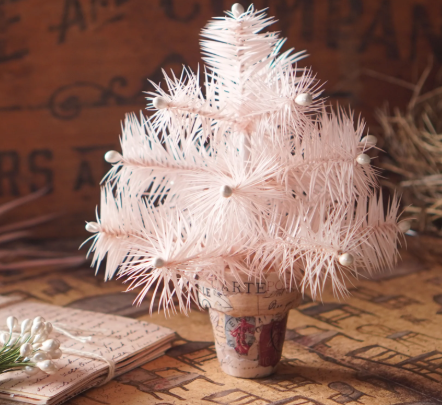
The response, somewhere around the 1880s, was the feather tree. Goose feathers were dyed green, wired onto wooden dowels, and assembled into a sparse, spindly approximation of a fir. They looked almost nothing like a real tree, with wide gaps between the branches and a distinctly handmade quality, and they were enormously popular. They were also, by accident, rather elegant, and the gaps between the branches meant candles could be clipped on without immediately setting the thing alight.
The Tree That Came from a Toilet Brush Factory
The next leap forward came from a decidedly unglamorous direction. In the 1930s, the Addis Brush Company in the United States, which manufactured household brushes, realised that the same machinery used to make toilet brushes could produce something that looked considerably more like pine needles than goose feathers did.
The resulting bristle trees were denser, greener and far more convincing than their feathered predecessors, and they could hold heavier ornaments. They were also fire resistant in a way that neither feathers nor a drying real fir had ever been, which mattered a great deal in an era of candlelit trees.
Aluminium and the Space Age
The 1950s and early 1960s produced the strangest chapter in the story. The aluminium Christmas tree, with metallic silver branches and a rotating colour wheel spotlight beneath it, was briefly the height of modernity. You could not put electric lights on them safely, hence the colour wheel, which bathed the whole thing in rotating red, green, blue and amber.
They were desperately fashionable and then, within about a decade, desperately unfashionable, helped on their way by a famous television special in which an aluminium tree stood in for everything commercial and hollow about the modern Christmas. Sales collapsed. The surviving examples are now collectors’ items.
The PVC Era
What replaced them is what most people over forty still picture when they hear the words artificial Christmas tree: PVC needles, cut from flat sheet into strips and twisted onto wire branches, in a colour of green not found anywhere in nature.
These trees were cheap, durable and unmistakably artificial. They are the reason the category spent several decades with a reputation problem. They also, to be fair, lasted an extraordinarily long time, which is why so many lofts still contain one.
Moulding, and the End of the Obvious Fake
The genuine technological shift arrived with injection-moulded polyethylene. Rather than cutting needle shapes from flat plastic, manufacturers began taking casts from real fir branches and moulding tips that reproduced the three-dimensional shape, the slight irregularity and even the surface texture of the original.
Combined with far higher branch densities and hinged construction, the result is a product that most people genuinely cannot identify as artificial from across a room. The best modern trees mix moulded tips on the visible outer branches with cheaper material deeper in, which is a sensible compromise between realism and cost. Anyone who has not looked at Dobbies.com or a comparable range in the last decade is usually surprised at how far the category has moved.
The British Adoption
The Christmas tree itself only became a British institution in the nineteenth century, and the usual account credits the royal household with popularising it. An illustration of Victoria and Albert gathered around a decorated tree, widely reproduced in the 1840s, is generally regarded as the moment the custom became aspirational rather than foreign.
The reality is a little more layered, as Queen Charlotte had introduced decorated trees to the English court decades earlier. The Royal Collection Trust holds material relating to these early royal Christmases, and the Victoria and Albert Museum’s collections of Christmas decorations and seasonal design trace how quickly the custom moved from court to middle-class parlour once the idea had taken hold.
The Hinge That Changed Everything
One unglamorous innovation deserves more credit than it gets. Until relatively recently, assembling an artificial tree meant slotting every branch individually into a numbered hole in the trunk, colour-coded by row, which on a large tree meant well over an hour of work each year and a bag of spare branches nobody could place.
Hinged construction, where branches are permanently fixed to the trunk and simply fold down into position as each section is lifted out of the box, cut that to a few minutes. It is probably responsible for more conversions from real trees to artificial ones than any amount of improvement in how the needles look.
What the History Tells Us
There is a tidy irony in all of this. The artificial tree was invented to conserve forests, spent a century being regarded as a cheap imitation, and has arrived in the present day as the option many households choose precisely on environmental grounds, provided they keep it long enough.
The feather tree makers of the 1880s would probably recognise the argument. They would be considerably more surprised by the moulded polyethylene.
What the Victorians Hung on Them
The decorations of the early British Christmas tree were largely edible or homemade, which is worth remembering when the modern version is accused of excess. Apples, nuts, sweets and small cakes hung from the branches, alongside candles clipped on in holders and, among wealthier households, small gifts tied directly to the tree.
Glass baubles, which now seem the most traditional element of all, arrived from Lauscha in Thuringia in the second half of the nineteenth century and were initially an expensive novelty. Tinsel was older still and originally made from thin strips of genuine silver, which tarnished badly and was eventually replaced by cheaper alternatives.
Every component of the tree, in other words, has been through at least one substitution already.
Why the Fake Tree Lost Its Stigma
For most of the twentieth century, admitting to an artificial tree carried a faint whiff of cutting corners. That has largely evaporated, and the reasons are worth noting because they are not only about the product improving.
Allergies became better understood. Flats got smaller and real trees became harder to transport and dispose of. Environmental thinking shifted from a simple natural-versus-plastic framing towards a question about how long a thing lasts. And a generation grew up for whom the perfectly symmetrical tree of their childhood was the nostalgic one.
See also: Los Angeles Private Security: Professional Protection for Businesses, Homes, and Events
A Tradition Made of Substitutes
It is worth remembering that almost every element of the modern Christmas tree is itself a substitute for something older. Electric lights replaced candles. Glass baubles replaced apples and nuts. Tinsel, originally made from real silver, was replaced by foil and then by plastic.
The tree has always been a composite of practical compromises dressed up as tradition. A moulded polyethylene fir is simply the most recent one, and in a hundred years it will presumably look as quaint as a goose feather tree does now.